
How to Install a Solar Integrated EV Charger at Home
Last Updated: October 31, 2026
Quick Summary
Solar integrated EV charging lets your roof panels power your car, with the charger drawing from household supply first and then from any surplus solar. A smart charger adjusts its speed to match spare output, and the inverter and charger must be compatible to share information. Charging during peak sunshine hours raises the share of solar energy you use.
- Check that your charger and inverter are compatible before buying, or they cannot share surplus power information.
- Estimate car load by multiplying daily kilometres by kWh per 100 km, then dividing by 100.
- Charging in the middle of the day is usually the cheapest way to raise your solar share.
- Confirm switchboard capacity first, since a single-phase home may have only 20-32 A spare.
- Ask for a commissioning record showing test results and settings to support future troubleshooting and warranty claims.
Table of Contents
- How Solar Integrated EV Charging Works
- Benefits of Charging Your EV With Solar
- Solar System Size for EV Charging
- Choosing a Smart EV Charger With Solar Surplus
- Step-by-Step Home EV Charger Installation
- EV Charging With Solar and Battery Storage
- Booking Your Solar EV Charging Installation
- Frequently Asked Questions
How Solar Integrated EV Charging Works
Solar integrated EV charging means your home panels generate power, and your electric vehicle charger draws some of that power to fill the car battery.
Here is the basic flow. Panels on your roof create direct current (DC) power. The inverter converts that power to alternating current (AC) for your home.
Three parts make it work:
- Solar panels: Capture sunlight and produce electricity during daylight hours.
- Solar inverter: Converts panel output to usable household power and manages export to the grid.
- EV charger: Controls how fast the car charges, often adjusting its speed to match spare solar output.
A common mistake is assuming every charger talks to every inverter. They do not.
Benefits of Charging Your EV With Solar
Charging from your own panels can cost less than charging from the grid. The exact saving depends on your electricity tariff, your daily driving, and how much of the charging happens during sunny hours.
Other benefits include:
- Lower running costs: Solar energy used at home avoids most grid charges.
- Lower emissions: Charging from your own panels produces no direct greenhouse gas emissions at the point of charging.
- Predictable fuel costs: Once the system is installed, the sun's energy costs you nothing.
Owners often find that charging during the day suits their routine best. Plan your charging around peak sunshine hours where you can. The more charging you match to daylight, the more of your own power you use.
Solar System Size for EV Charging
The right system size depends on two things: how much power your household uses, and how much your car needs. An undersized system leaves the car drawing from the grid. An oversized one costs more than it saves.
Our Solar Systems - 6.6 kW package is designed around a daily production range of 25 to 40 kWh, though actual output varies with location, roof orientation and shading.

If your household already uses a lot of power, or you drive a large amount each week, consider a bigger system. Our Off Grid Systems range includes 20 kWh battery storage.

Working Out Your Household and Vehicle Load
Start with your electricity bill. Find your average daily use in kilowatt-hours (kWh). Then estimate how many kilometres you drive each day and how much energy your car uses per kilometre.
Here is a simple way to estimate the car's daily load:
- Note your average daily driving distance in kilometres.
- Multiply that by your vehicle's energy use per kilometre (usually listed in kWh per 100 km).
- Divide by 100 to get the kWh needed each day.
For example, a car using 18 kWh per 100 km driven 40 km per day needs about 7.2 kWh of charge daily. Add that to your household use to size your solar system.
Watch out: sizing only for today's usage can leave you short when you buy an EV later. Plan for the charging you expect in the next few years.
Estimating Surplus Solar, Charging Time and Solar Share
A system can be the right size on paper and still deliver little solar to the car if charging happens when the house is using most of the generation.
Surplus solar at charging time. Take the system's output during the hours you charge and subtract household load.
Charging time from surplus. Divide the energy the car needs by the spare power.
Solar share of the vehicle's energy. Compare the energy delivered in solar-following mode with the car's total daily need.
How System Configuration Changes Charger Operation
The same charger behaves differently depending on how the solar system is configured.
- Grid-connected with solar-following: The charger uses surplus first and tops up from the grid when needed. This is the most flexible setup and the easiest to live with.
- Export-limited: Some connections limit how much power can be sent to the grid. In that case, surplus that would otherwise be exported can be diverted to the car, making charging a useful way to use generation that would be curtailed. The charger must respond quickly to changing surplus to capture this.
- Off-grid: There is no grid to fall back on, so charging must fit within what the panels and battery can supply. Charging rates are usually lower, and scheduling around battery state of charge matters more than in a grid-connected home.
Ask your installer which configuration applies to your connection before choosing a charger, because it determines whether solar-following mode, export limiting or battery management will do most of the work.
Choosing a Smart EV Charger With Solar Surplus
A smart charger can change its charging speed based on spare solar power. This lets the car use free energy from your roof without drawing from the grid.
Look for these features when choosing a charger:
- Solar surplus mode: Adjusts charging speed to match spare solar output.
- Compatibility: Works with your inverter and communicates with your energy system.
- Minimum charging power: Check the lowest power the charger can run at. Many cars need a minimum output to start charging.
Speak to your installer about which chargers suit your inverter.
Step-by-Step Home EV Charger Installation
A typical installation follows a clear sequence. Each step must be completed before the next one starts, and the electrical checks in steps 1 to 3 often determine whether the job is a straightforward fit or needs an upgrade.
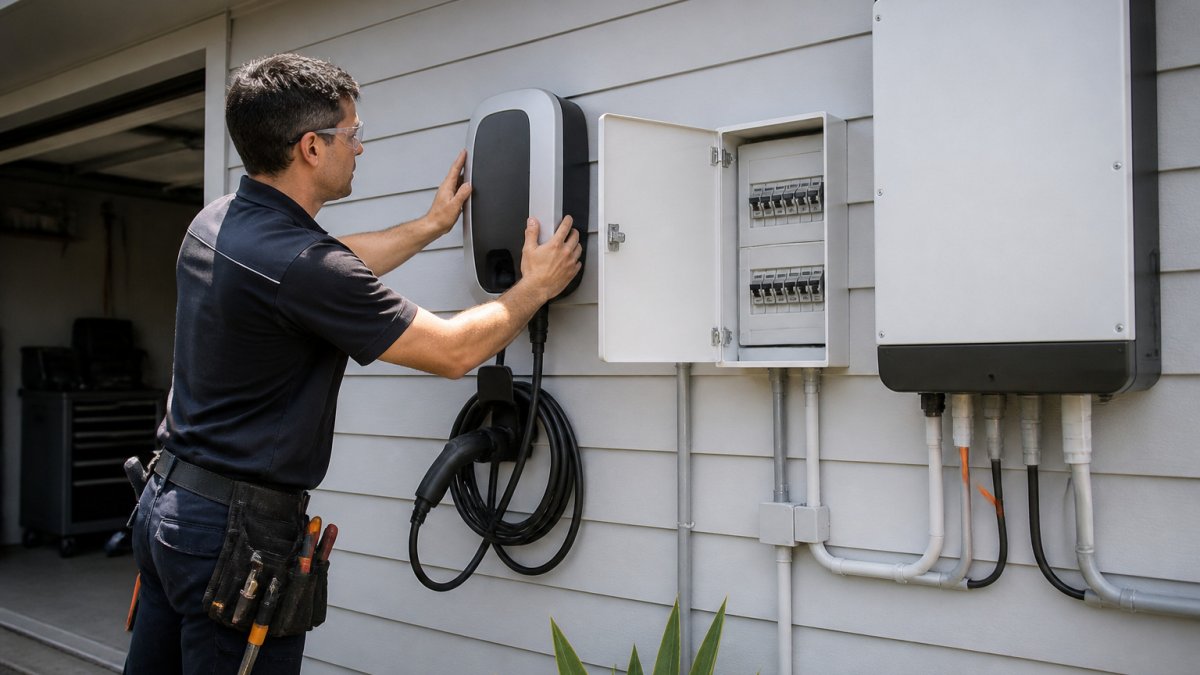
!A licensed electrician in work clothing mounting a wall-mounted EV charger on an exterior garage wall beside a residential switchboard, with a solar inverter visible nearby
- Site assessment and design: An electrician inspects your switchboard, meter box, cable route and charger location. They confirm your supply type (single-phase or three-phase), the main switch rating, and whether there is space for a dedicated circuit breaker. The charger model, cable size and route are chosen at this stage.
- Confirm capacity and load management: Check the switchboard can handle the extra load. A single-phase home with a 63 A main switch may only have 20-32 A spare after existing circuits; a 7 kW charger draws about 32 A on single-phase, so load management or an upgrade may be required. Three-phase supply allows higher charging rates and better phase balancing.
- Mount the charger: Fix the unit to a wall at a suitable height (typically 1.0-1.5 m to the connection point), sheltered from direct weather. Confirm the mounting surface can carry the unit and that the cable entry is accessible for service.
- Run the cable: Install the cable from the switchboard to the charger following safe routes, using the cable size specified for the charger's rating and run length. Longer runs need larger conductors to limit voltage drop; keep the charger as close to the switchboard as practical.
- Connect and test: Wire the charger to its dedicated circuit, switch it on, and verify earth continuity, insulation resistance and polarity before energising. Confirm the charger communicates with your inverter or energy management system if solar-following mode is being used.
- Commission and hand over: Program the schedule, solar mode and any tariff settings. Test a full charging session, check the reported charging power matches expectations, and confirm the app or portal shows live data. Walk the owner through fault indicators and the isolation procedure.
Only licensed electricians should carry out this work. Our packages list SAA accredited electricians as part of the service.
Site Assessment, Switchboard Capacity and Cable Runs
Your switchboard is the first thing to check. Older homes often have limited capacity, and an EV charger may need a dedicated circuit or an upgrade.
Supply type matters. Single-phase homes typically support charging at around 7 kW; three-phase homes can support higher rates and spread load across phases.
Cable length matters too. Longer runs cost more and lose more power through voltage drop.
Commissioning, Testing and Troubleshooting
Commissioning is where a good installation proves itself. After wiring, the electrician should test earth continuity, insulation resistance and polarity, then energise the circuit and confirm the charger starts a session at the expected power.
For solar-integrated systems, test solar-following mode on a sunny day: confirm the charger ramps charging up and down as surplus changes, and that it does not import from the grid when set to solar-only.
Common faults to check before calling for service:
- Charger will not start: Confirm the vehicle's minimum charging power is met; some cars need a few amps before they begin charging.
- Charging slower than expected: Check whether solar-following mode is limiting output, or whether load management has reduced the rate.
- Lost connectivity: Recheck the Wi-Fi or wired connection between charger, inverter and router.
The installation follows six steps, and the electrical checks in the first three often decide whether the job is a simple fit or needs an upgrade.
| Step | What to do | Time or frequency |
|---|---|---|
| 1. Site assessment and design | Inspect switchboard, meter box, cable route and charger location | Before purchase |
| 2. Confirm capacity | Check switchboard can handle the extra load | Before installation |
| 3. Mount the charger | Fix unit to wall at 1.0-1.5 m, sheltered from weather | Installation day |
| 4. Run the cable | Install cable sized for charger rating and run length | Installation day |
| 5. Connect and test | Verify earth continuity, insulation resistance and polarity | Before energising |
| 6. Commission and hand over | Program schedule, solar mode and tariff settings | Final step |
EV Charging With Solar and Battery Storage
Adding battery storage lets you use solar power after the sun goes down.
Batteries also let the car charge at a steady rate regardless of cloud cover. The trade-off is cost, since batteries add to the upfront price. Calculate how often you charge after dark before deciding.
Sunfire Electrical specialises in grid-tied and battery-ready hybrid systems. Our Off Grid Systems package includes 20 kWh Dyness batteries.
Booking Your Solar EV Charging Installation
Ready to start? Sunfire Electrical offers a free quote and site inspection.
Pricing for the Solar Systems - 6.6 kW package starts from $4,588 AUD, with the total depending on your site and tariffs.
Get started with Sunfire Electrical and charge your car from your own roof. Our installations come with a 10-year installation warranty.
Frequently Asked Questions
Can solar panels charge an electric vehicle directly?
Solar panels produce DC power that an inverter converts to AC for the home. An EV charger then draws that AC power, so panels charge the car indirectly through the home system. A smart charger can prioritise surplus solar generation, so charging happens mainly when the panels produce more than the house uses. Charging overnight from grid power is still needed on cloudy days or when the car needs more energy than the solar surplus provides.
What size solar system do I need to charge an EV?
Sizing depends on how many kilometres you drive and how much of the charging you want from the sun. A single-phase 6.6 kW solar system from Sunfire Electrical, priced from $4,588 and producing roughly 25 to 40 kWh a day (prices and production vary by site), produces roughly 25 to 40 kWh a day. Your installer should model your daily household load and vehicle kilometres before recommending a system size.
Do I need a battery to charge an EV with solar panels?
No. A solar system without a battery can still charge an EV using surplus daytime generation, provided a smart charger can adjust its charging rate to match what the panels produce. A battery adds flexibility because it stores extra solar for evening charging, which increases the share of the car's energy that comes from your own panels.
How much does it cost to install a home EV charger with solar?
Installation cost depends on switchboard capacity, cable run length, charger location and whether any electrical upgrades are needed. Sunfire Electrical's solar packages start from $4,588 for a 6.6 kW grid-tied system, and Sunfire Electrical offers a free quote and site inspection. Ask for an itemised quote so you can see the charger, cabling, switchboard work and commissioning costs separately.
