
How Can You Reduce Electricity Bills in WA?
Last Updated: October 25, 2026
Quick Summary
To reduce electricity bills in WA, read your bill first to separate usage charges from fixed supply charges, then cut usage through heating and cooling settings, standby power cuts and LED lighting. Shifting daytime usage to your own solar and checking unclaimed concessions adds further savings.
- Set heating to around 18-20°C in winter and cooling to 24-26°C in summer.
- Switch off appliances at the wall to cut standby power across the home.
- A 6.6 kW solar system is fully installed at $3,588 for most single-phase homes.
- Ask your retailer which concessions are applied and which you are missing.
- Renters can swap to LED bulbs and use draught stoppers at doors and windows.
Table of Contents
- Read Your Bill First: Diagnosing Where the Money Goes
- How to Save Electricity at Home: Low-Cost Steps That Work
- Residential Solar Savings: What You Can Realistically Expect
- Home Battery Cost and Savings: Is Storage Worth Adding?
- Electricity Bill Concessions Western Australia: Support You May Be Missing
- Renters, Apartments and Shared Households: What You Can Still Do
- Get a Free Quote and Site Inspection
- Frequently Asked Questions
Read Your Bill First: Diagnosing Where the Money Goes
Most households try to reduce electricity bills by guessing. They switch off a few lights, then wonder why the bill barely moves. Learning how to reduce electricity bills WA households face starts with one boring but powerful step: reading the bill properly. At Sunfire Electrical, we see this constantly.
Your bill has two main parts, and they behave very differently.
Usage vs Supply Charges
Usage charges are what you pay for each unit of electricity you actually consume. Supply charges are a fixed daily amount, charged whether you use any power or not.
That split matters. No amount of switching off lights will shrink the supply charge. Only your usage responds to habit changes.
- Usage charges: based on kilowatt hours used, so they respond to behaviour
- Supply charges: a fixed daily fee, so they stay put no matter what you do
- A bill that keeps climbing despite careful habits usually points to usage, not supply
Checking Your Meter and Tariff
Your tariff is the pricing structure applied to your usage. Time-of-use tariffs charge different rates at different times of day.
Check your meter against your bill. If the numbers don't line up, call your retailer before assuming the worst.
Ask your retailer one question: which tariff am I on, and when are the peak windows? That single answer shapes everything below.
How to Save Electricity at Home: Low-Cost Steps That Work
Saving power at home comes down to three areas: heating and cooling, appliance habits, and the building shell itself. None of these require a big spend, and most pay back within weeks. Here is how we would work through them, cheapest first.
Heating, Cooling and Temperature Settings
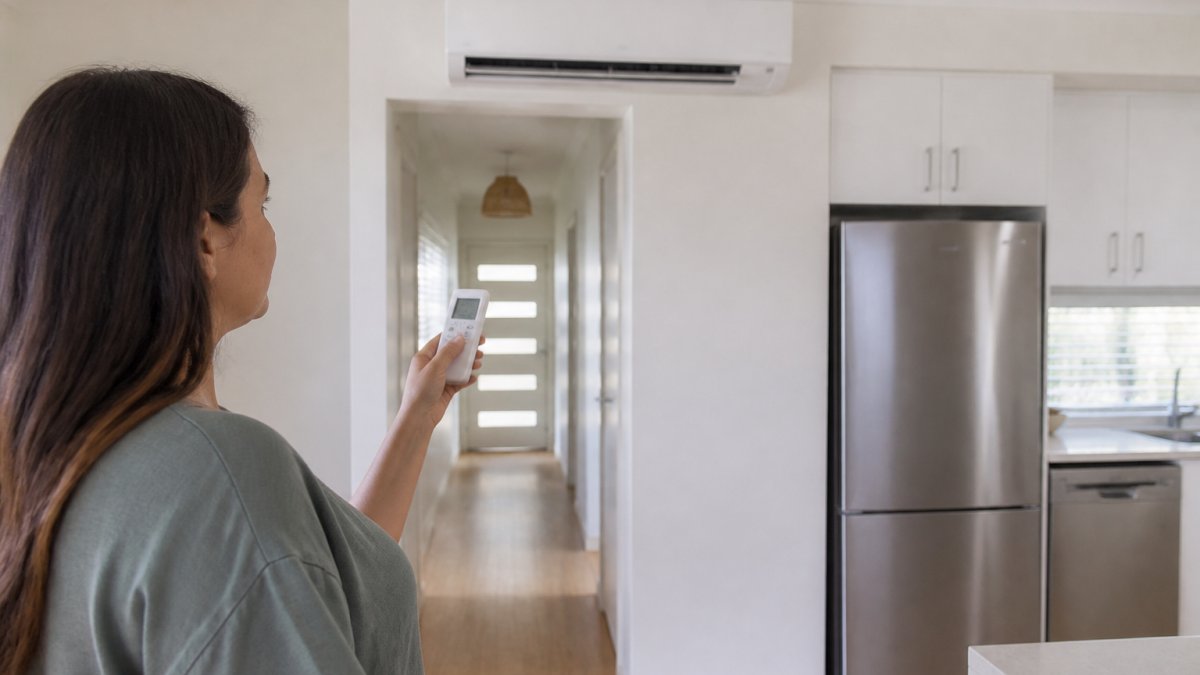
Heating and cooling are usually the biggest slice of a household bill. Every degree of extra heating or cooling adds running cost, so small temperature shifts matter more than most people expect.
- Set heating to around 18-20°C in winter and cooling to 24-26°C in summer
- Close doors to rooms you aren't using
- Clean filters regularly so the system doesn't work harder than it needs to
Appliances, Standby Power and Full Loads
Standby power is the electricity appliances draw while switched off but still plugged in. It sounds trivial. Across a whole home, it adds up.
- Switch off appliances at the wall when not in use
- Unplug chargers, consoles and set-top boxes
- Run the washing machine and dishwasher only with full loads
LED Lighting, Insulation and Draught Sealing
LED lighting uses far less power than older bulbs and lasts years longer. Swap the highest-use lights first: kitchen, living room, hallway.
Insulation and draught sealing stop the air you paid to heat or cool from escaping. Seal gaps under doors and around windows.
None of this is glamorous. All of it shows on the next bill.
Here are the low-cost steps we would work through, cheapest first.
| Area | What to do | Detail |
|---|---|---|
| Heating | Set heating to around 18-20°C in winter | Every extra degree adds running cost |
| Cooling | Set cooling to 24-26°C in summer | Use fans with the air conditioner |
| Air conditioner | Clean filters regularly | Stops the system working harder than needed |
| Standby power | Switch off appliances at the wall | Unplug chargers, consoles and set-top boxes |
| Laundry and dishes | Run only with full loads | Wash in cold water where the load allows |
| Fridge | Check door seals with a sheet of paper | Retire the second fridge if it runs empty |
| Lighting | Swap highest-use lights to LED first | Kitchen, living room, hallway |
| Building shell | Seal gaps under doors and around windows | Close curtains before the afternoon sun in summer |
Residential Solar Savings: What You Can Realistically Expect
Most solar articles tell you that savings 'depend on your situation' and stop there. That is true but useless. What you actually need is a transparent way to estimate your own savings, with the assumptions laid out so you can judge whether they match your household. Here is that framework.
The three variables that drive your savings
Every solar savings estimate comes down to three numbers:
- Self-consumption, the share of solar generation you use in your own home rather than export to the grid. This is the single biggest driver of savings, because self-consumed power offsets your retail usage rate, while exported power earns only a feed-in credit (usually much lower).
- Your usage tariff, the rate you pay per kilowatt hour. A higher tariff means each self-consumed kilowatt hour saves more.
- System size and generation, how much power the system produces, which depends on size, roof orientation, shading and local sunlight hours.
A worked example with stated assumptions
Rather than quote a single savings figure, here is how to build your own estimate. The assumptions below are illustrative, substitute your own bill and generation figures.
- Assume a 6.6 kW system generates roughly 25-30 kWh per day on average across the year in a typical location. Actual generation varies with season, orientation and shading.
- Assume your household self-consumes 40% of that generation and exports the rest. A household that is home during the day may self-consume 60% or more; a household that is out all day may self-consume 20-30% unless it shifts loads.
- Assume a retail usage rate and a feed-in rate from your own bill. The gap between these two rates is why self-consumption matters so much.
With those inputs, your annual bill impact is roughly:
(self-consumed kWh × usage rate) + (exported kWh × feed-in rate)
Run that against your actual bill and you get a savings range, not a promise. A household with high daytime usage and a high tariff will land at the top of the range; a household that exports most of its generation will land near the bottom.
Shifting usage to capture more of your own solar
The cheapest way to improve solar savings is not a bigger system, it is using more of what you already generate:
- Run the dishwasher and washing machine during daylight hours, ideally on a delay timer.
- Heat water on a timer if you have a suitable system.
- Charge devices and an electric vehicle while the sun is up.
Each of these shifts raises self-consumption, which is the variable with the largest effect on your return.
Payback, honestly framed
Payback is simply the upfront cost divided by annual bill savings. It is sensitive to the assumptions above, so treat any payback figure as a range.
For a clear starting point, look at our 6.6 kW solar system package, fully installed at $3,588. If you want to compare current package pricing before deciding, our solar power special offers page is the place to start.

A common mistake is buying the biggest system quoted rather than the one that matches your daytime usage. Size to your habits, not to the sales pitch.
Home Battery Cost and Savings: Is Storage Worth Adding?
A battery changes the maths. It stores daytime solar so you can use it at night, when tariffs are usually higher.
The trade-off is upfront cost.
Ask yourself three questions:
- Do you use most of your power in the evening?
- Is your daytime solar currently exporting rather than being used?
- Do you want backup power during outages?
If you answer yes to most of these, storage is worth pricing.
Watch out: sizing a battery to your whole evening load rather than your overnight usage is the most common way people overspend.
Electricity Bill Concessions Western Australia: Support You May Be Missing
Concessions and rebates exist, and many eligible households never claim them. The problem is that most guides list vague categories and tell you to 'check the government website'. That is not actionable. Here is a more useful way to work through what is available, what each type of support actually does to your bill, and how to confirm your own eligibility.
The main categories of support
Support generally falls into four buckets, and they behave differently:
- Ongoing concessions, a fixed amount or percentage applied to your bill each period, usually via your retailer once you are registered. These reduce your bill steadily rather than in one lump.
- One-off rebates and relief payments, a set amount paid once, often during a cost-of-living period. These do not change your underlying usage cost.
- Hardship programs, retailer-run arrangements for households in payment difficulty. These can include payment plans, extensions, and sometimes debt relief. They are not advertised loudly, so you usually have to ask.
What to check, and in what order
Work through these in sequence, because some support depends on others:
- Concession cards and health care cards. If you hold a relevant card, ask your retailer whether a concession is already applied to your account. A common pattern is that eligible households are registered for one concession but not another they also qualify for.
- Seniors and pensioner concessions. These are typically separate from general energy concessions and may have different thresholds. Confirm both, not just the one you have heard of.
- Retailer hardship programs. Call your retailer and ask directly: 'What hardship support do you offer, and how do I apply?' This is the single most under-used lever. Retailers are required to have hardship policies, but they rarely volunteer them.
- Emergency and community assistance. If you are in immediate difficulty, community organisations and local support services can often point you to emergency payments faster than a government portal.
How to verify amounts and eligibility
Amounts, thresholds and scheme names change, sometimes annually. Do not budget around a figure you saw in an article (including this one). Instead:
- Check the official government energy support pages for the current list of schemes and eligibility criteria.
- Ask your retailer to confirm in writing which concessions are applied to your account and which you may be eligible for but are not receiving.
- Keep a record of the date you checked, because eligibility rules can shift between billing periods.
If you are unsure what applies to your situation, our FAQs cover the questions we hear most about support, rebates and next steps. A short call to your retailer or the relevant agency often uncovers support you did not know existed.
Renters, Apartments and Shared Households: What You Can Still Do
Renting doesn't mean you're stuck. You just have fewer levers, so pull the ones you have harder.
- Swap to LED bulbs; keep the old ones to refit when you leave
- Use draught stoppers at doors and windows
- Ask the landlord about insulation or efficient appliances; some will act on a polite written request
Apartments benefit most from heating, cooling and standby cuts, since the building shell is out of your hands. Solar usually isn't an option for renters, but a portable setup for small loads can help in some cases.
The habits above work regardless of who owns the walls.
Get a Free Quote and Site Inspection
Every home is different. Usage patterns, roof orientation, shading and tariffs all change what a system will actually deliver. That's why we start with a site inspection rather than a sales call.
Here's what we bring to that visit:
- A clear read of your usage and tariff so the system matches your habits
- Advice on grid-tied or battery-ready hybrid options, sized to your home
- A 10-year installation warranty for long-term peace of mind
We're Australian owned and operated, and we'd rather size a system correctly than oversell one. If you'd like to talk it through, contact us to arrange your free quote and site inspection.
Frequently Asked Questions
How can I reduce my electricity bill in Western Australia?
Start by reading your bill to separate usage charges from supply charges, then target the biggest users: heating and cooling, hot water, and appliances on standby. Set your air conditioner to 24°C in summer and 18°C in winter, run full loads in the washing machine and dishwasher, seal draughts, and switch to LED lighting. For longer-term savings, compare residential solar savings against your usage profile and check whether you qualify for electricity bill concessions Western Australia offers.
What uses the most electricity in a typical home?
Heating and cooling usually top the list, followed by hot water systems, refrigeration, and appliances like washing machines, dryers and dishwashers. Standby power from TVs, computers and chargers adds up quietly across the year. Reading your meter before and after running specific appliances is the simplest way to confirm what is driving your electricity consumption, rather than guessing from the bill total alone.
Does rooftop solar reduce electricity bills in Western Australia?
Yes. A well-sized system generates power during the day, and using that power in the home cuts the amount you buy from the grid. Sunfire Electrical's 6.6 kW grid-tied package is listed at $3,588 and is estimated to produce 25 to 40 kWh daily, with savings up to $2,000 per annum depending on location, tariffs and usage. Actual residential solar savings vary, so a site inspection and custom yield estimate matter before you commit.
Is a home battery worth it for reducing electricity costs?
It depends on your usage pattern. A battery stores daytime solar for evening use, which helps if you are home after dark and on time-of-use tariffs. Home battery cost and savings vary widely with capacity and how much stored energy you actually use. Sunfire Electrical's off-grid package, listed at $17,771, includes 20 kWh of battery storage and is aimed at rural and semi-rural homes where grid connection is expensive or unreliable.
Your bill won't fix itself, and guessing at cuts wastes time you could spend saving. Start with the bill, work through the low-cost steps, then decide whether solar or storage makes sense for your home. Get started with Sunfire Electrical and book a free site inspection to see exactly what your household could save.
