
Solar panel warranty coverage explained 2026
Last Updated: October 26, 2026
Quick Summary
Solar panel warranty coverage explained includes product warranties covering manufacturing defects, performance warranties guaranteeing minimum energy output, and installation workmanship warranties covering installation issues. Each component has different coverage terms, and warranties typically do not cover diagnosis, removal, freight, or roof access costs.
- Solar panels typically have 10-12 year product warranties and 25-30 year performance warranties
- Product warranties cover delamination, junction box failure, and cell defects but exclude storm damage and improper installation
- Warranty coverage does not automatically include labour, freight, diagnosis, or roof access costs
- Lodge claims in writing with proof of purchase, warranty terms, monitoring data, and photographs of defects
- Straightforward warranty claims typically take 1-3 months from lodgement to resolution
Table of Contents
- Understanding solar panel warranty coverage
- Solar panel product warranty explained
- Solar panel performance warranty guarantees
- Solar installation workmanship warranty coverage
- Australian Consumer Law and manufacturer warranties
- How to lodge a solar warranty claim
- Protecting your warranty and system longevity
- Getting your solar warranty assessment with Sunfire Electrical
- Frequently Asked Questions
Understanding solar panel warranty coverage
Solar panel warranty coverage explained in 2026 is one of the most important decisions you'll make when investing in a residential system. Without understanding what your warranty covers, you could face unexpected costs years after installation.
A solar system may have product, performance, and installation workmanship warranties. Each can cover different failures and components.
Solar panel product warranty explained
A product warranty may cover manufacturing defects in physical components. Check the warranty terms to see which components and faults are covered.
Coverage is component-by-component, not system-wide
Read each component's warranty document to check its terms and identify whom to contact about a failure.
| Component | Typical product warranty | What is usually covered | What is usually excluded |
|---|---|---|---|
| Solar panels | 10-12 years (product); 25-30 years (performance) | Delamination, junction box failure, cell defects, backsheet failure | Storm damage, impact, vermin, improper installation |
| Inverter | 5-10 years (extendable at cost) | Internal electronics failure, firmware faults, display failure | Surge damage, water ingress from poor mounting, lightning |
| Battery | 10 years or a specified throughput | Cell failure, capacity below guaranteed threshold, BMS faults | Over-temperature from poor siting, unauthorised firmware changes |
| Mounting hardware | 5-10 years (varies widely) | Corrosion of rails and clamps, structural failure of the rail | Roof structure failure, incorrect installation, coastal salt exposure beyond rating |
| Cabling and isolators | Often 5 years or tied to the workmanship warranty | DC connector failure, isolator failure | UV degradation from exposed wiring, rodent damage |
| Labour | Usually tied to the workmanship warranty, not the product warranty | Removal and reinstallation where the manufacturer agrees | Diagnosis, scaffolding, freight in many cases |
Who pays for diagnosis, removal, freight and reinstallation
A warranty promising a replacement panel may not cover every related cost, so check its terms for:
- Diagnosis, the technician's time to confirm the fault. Some manufacturers reimburse this if the claim is approved; many do not.
- Removal and reinstallation, taking the faulty panel off the roof and fitting the replacement. Often covered only if the original installer is still trading and willing to do the work under their own warranty.
- Freight, returning the faulty component and delivering the replacement. Frequently at the owner's cost unless the terms say otherwise.
- Roof access, scaffolding, harness systems or elevated work platforms, which can be a significant cost on a two-storey home.
Ask the manufacturer in writing which of these they will meet before authorising any work.
Common defects covered
Common defects covered include delamination (panel layers separating), cell cracking (internal fractures in the silicon cells), and junction box failure, manufacturing issues, not installation problems or environmental damage. Inverters commonly fail at the internal electronics or display, and batteries at the cell or battery management system level.
Provider risk: will the warranty still exist in 15 years?
Before relying on a long warranty, consider:
- Who is the warrantor? Is it the manufacturer, a local distributor, or a third-party insurer?
- Is there local support? Check what support and parts arrangements the manufacturer provides.
- What happens on insolvency? Check the warranty terms to understand what happens if the manufacturer or installer ceases trading.
- Is the warranty transferable? If you plan to sell, check the warranty terms.
How this interacts with your statutory rights
Product warranties sit alongside, not above, the consumer guarantees in Australian Consumer Law. If a product fails to be of acceptable quality within a reasonable period, you may have a remedy even where the manufacturer warranty has expired or excludes the fault. Keep your proof of purchase and installation records in case you need to escalate.
Solar panel performance warranty guarantees
A performance warranty sets out a minimum energy output level for solar panels over a stated period. It differs from a product warranty, so check the terms of each.
Solar installation workmanship warranty coverage
An installation workmanship warranty sets out the installation-related issues covered by its terms. Check the warranty document for the specific coverage.
Sunfire Electrical backs installations with a 10-year installation warranty.
Australian Consumer Law and manufacturer warranties
A common misunderstanding is that a warranty disclaimer removes your consumer rights. It does not, disclaimers cannot exclude or limit your statutory consumer guarantees under Australian law.
How to lodge a solar warranty claim
You can organise a warranty claim by gathering relevant documents and checking the warranty terms before contacting the relevant party.
Step 1: Confirm which warranty applies
Before you contact anyone, identify the likely cause. This determines who is responsible:
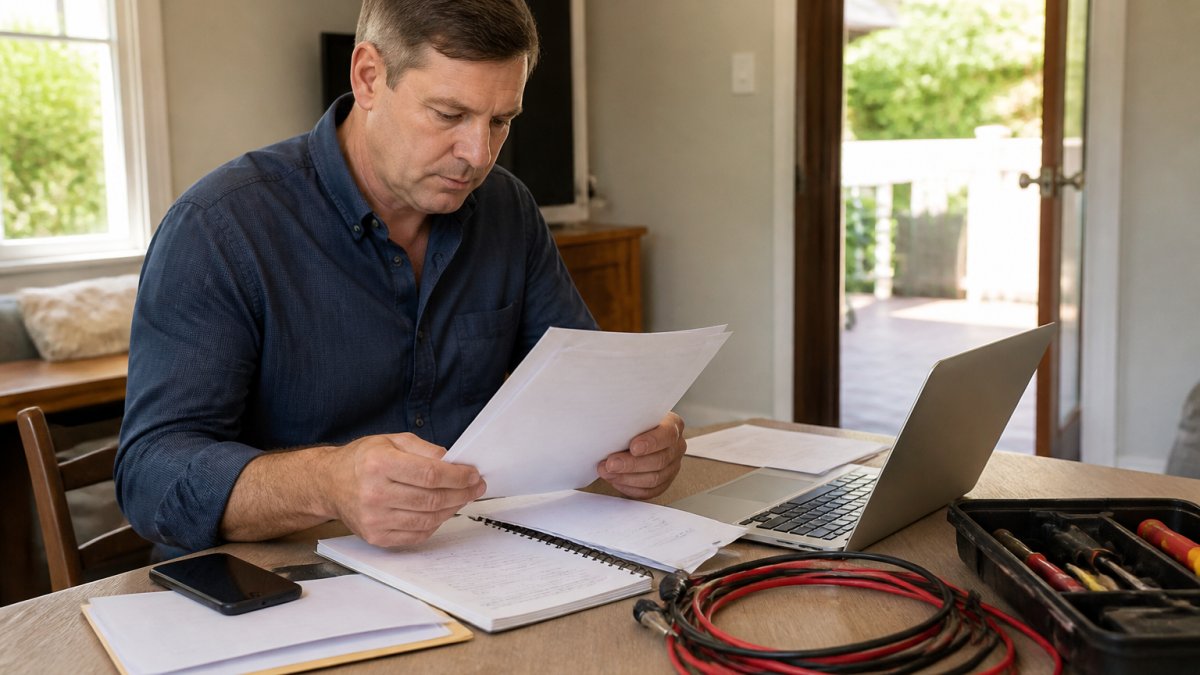
Step 2: Build an evidence pack
A claim without evidence is a conversation; with evidence, it's a case. Assemble the following before lodging:
- Proof of purchase and the installation invoice.
- The warranty certificate or terms for each component.
- At least three to six months of monitoring data for performance claims, exported as a CSV or PDF rather than screenshots alone.
- Dated photographs of any visible defect, plus wider shots showing the panel's position on the roof.
- A short written timeline: when you first noticed the issue, what you observed, and any error codes displayed.
- Records of any maintenance or inspections already carried out.
Step 3: Lodge in writing and set expectations
Keep a written record of your claim and the information you provide.
Step 4: Understand who pays for what
This is the most common source of dispute. A warranty covering the replacement panel doesn't necessarily cover the cost of getting to it:
- Diagnosis, often the owner's cost unless the fault is confirmed as covered.
- Removal and reinstallation, some manufacturers cover labour, many do not; check the terms.
- Freight, returning a panel or inverter may be at the owner's expense unless the warranty states otherwise.
- Roof access and safety, scaffolding or elevated work platform costs are frequently excluded.
Check the warranty terms before authorising any work.
Step 5: Escalate if the claim is refused
If a claim is denied, review the warranty terms and consider seeking independent advice.
Realistic timelines at a glance
| Stage | Typical duration |
|---|---|
| Acknowledgement of claim | 2-5 business days |
| Technical assessment | 2-4 weeks |
| Site inspection (if required) | 4-6 weeks from lodgement |
| Replacement parts ordered | 2-8 weeks depending on stock |
| Resolution and close-out | 1-3 months total for straightforward claims |
What a strong claim looks like
A claim that gets resolved quickly usually has four features: it is lodged in writing, it names the correct responsible party, it includes monitoring data rather than opinion, and it asks for a specific remedy. A claim that stalls usually lacks one of these, most often the monitoring data, because owners rely on the app's summary screen rather than exporting the underlying figures.
Protecting your warranty and system longevity
Keep relevant documentation, such as purchase receipts, installation invoices, warranty certificates, maintenance records, and monitoring data.
Check the warranty terms to find out whether the warranty transfers if you sell your home.
Getting your solar warranty assessment with Sunfire Electrical
When you're ready to discuss a new installation, contact Sunfire Electrical directly.
For homeowners considering a new solar system, we provide free quotes and site inspections. Our 6.6 kW solar systems come with a 10-year installation warranty.

If you want to explore options for a new system, our FAQs address common questions. Reach out today to discuss your solar system needs.
Frequently Asked Questions
What is the difference between a solar panel product warranty and a performance warranty?
A solar panel product warranty and a performance warranty are different types of warranty. Check the terms to see what each covers and for how long.
Does a solar installation warranty cover roof leaks?
Sunfire Electrical provides a 10-year installation warranty. Check the warranty terms for details of its coverage.
How long do solar panel and inverter warranties last?
Warranty periods and terms vary. Check the warranty documents for the specific system and components.
What does Australian Consumer Law say about solar warranties?
Australian Consumer Law provides statutory consumer guarantees that run parallel to manufacturer warranties. These guarantees require goods to be safe, of acceptable quality, and fit for purpose for a reasonable time. For solar systems, this typically means 5-7 years for major components. If a manufacturer warranty is shorter or excludes issues covered by consumer law, the consumer guarantee applies. These rights cannot be excluded by warranty disclaimers.
What should I do if my solar panels or inverter fail?
Check the relevant warranty terms and contact the appropriate party to ask about the process for raising a claim.
Can I transfer my solar warranty if I sell my home?
Check the warranty documents to find out whether a warranty transfers to a new owner and whether any steps are required.
What happens if my solar installer goes out of business?
If your installer becomes insolvent, you lose recourse for installation workmanship claims through that business. However, manufacturer product and performance warranties remain valid and can be claimed directly from the panel or inverter manufacturer. Some installers carry warranty insurance or join industry schemes that protect customers if the installer fails. Before installation, ask whether your installer is covered by such protection and obtain written confirmation of warranty terms from both the installer and manufacturer.
Your solar investment deserves protection that you actually understand. Warranty confusion costs homeowners time and money when problems arise. Sunfire Electrical's 10-year installation warranty, combined with manufacturer product and performance guarantees, ensures your system is covered across all three layers. Get in touch with our team to review your warranty options and find the solar solution that fits your needs and budget.
